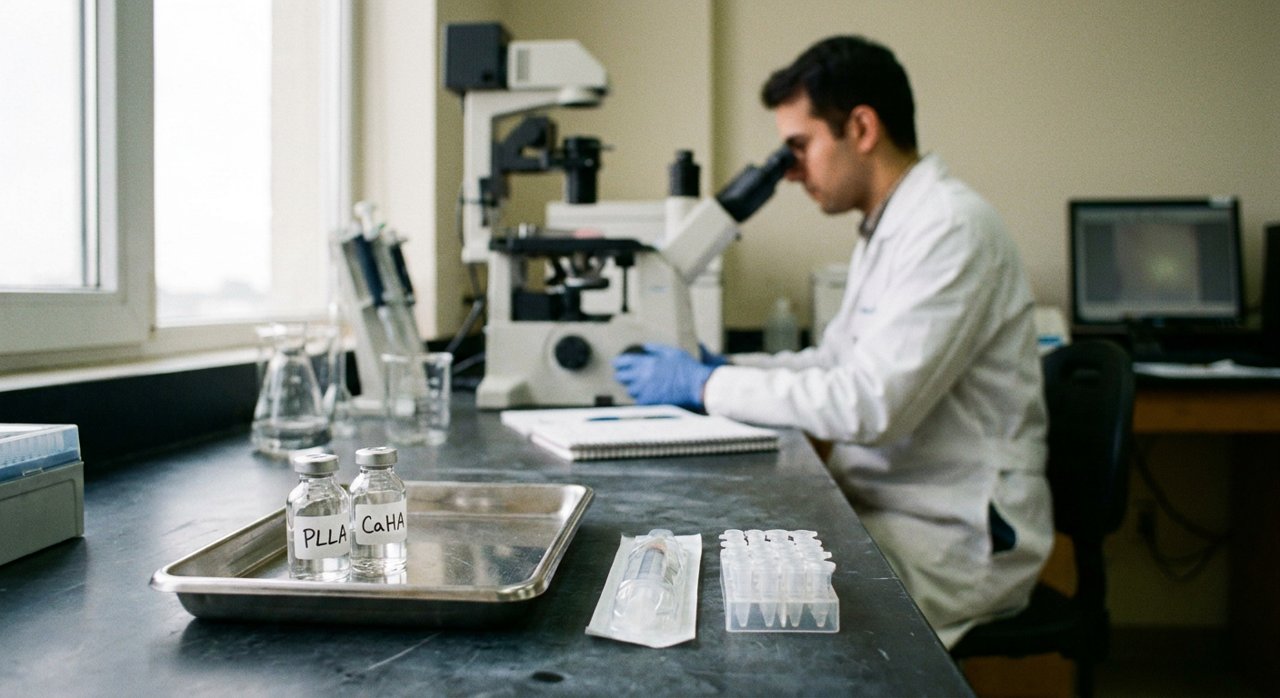
Published in Aesthetic Plastic Surgery on November 3, 2025, this PRISMA-2020 systematic review (PubMed/Medline, Scopus, BVS) pulled 14 eligible studies that directly compare facial poly-L-lactic acid (PLLA) and calcium hydroxyapatite (CaHA) biostimulators on efficacy, durability, and safety.
On efficacy the two are close. Both produced significant gains in skin elasticity, wrinkle reduction, and facial volume. Durability is where they part. PLLA maintained results up to about 25 months, while CaHA lasted roughly 12 to 18 months. The mechanism explains the curve. PLLA drives gradual, inflammation-dependent neocollagenesis (an M2 macrophage, TGF-beta-Smad foreign-body response), so the result builds over months. CaHA adds an immediate microsphere scaffold on top of collagen stimulation, so it does more on day one. Safety was acceptable for both, and nodules remain the characteristic PLLA risk, tied closely to dilution, reconstitution, and injection technique rather than the molecule alone.
The decision rule: when durability is the deciding factor, PLLA outlasts CaHA, roughly two years versus one to one-and-a-half. Choose CaHA when the patient wants more immediate lift. Choose PLLA when you want a slow-build, longer-tail structural result, and say so up front: PLLA improves over several months, not on the drive home. If you are planning multiple sessions, sequence the PLLA earlier so its neocollagenesis has time to mature before you judge the final result.
Source: Aesthetic Plastic Surgery — https://doi.org/10.1007/s00266-025-05412-8