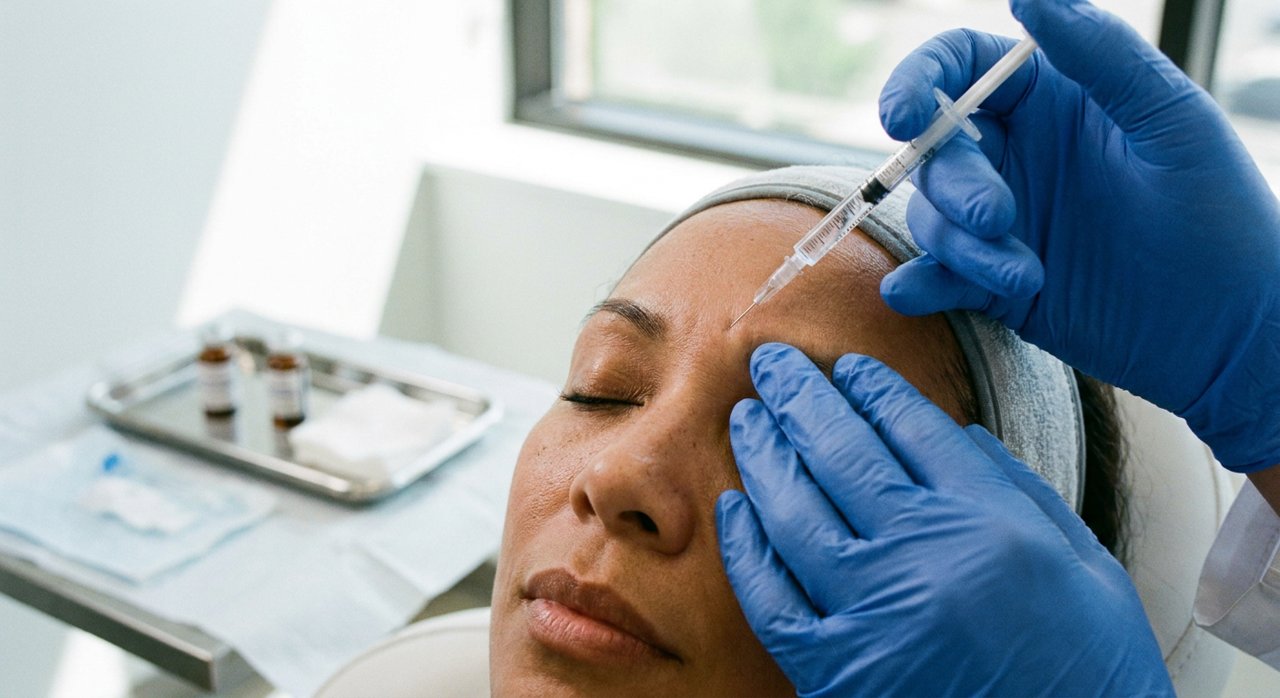
A lot of injector training teaches you to read the patient's glabellar contraction pattern and customize your points to it. This study asked whether that step earns its keep. Published April 12, 2025 in the Journal of Cosmetic Dermatology, it was a retrospective investigation of 42 Brazilian multi-ethnic patients with moderate-to-severe glabellar lines, all treated with the same standardized 3-point technique: 37.5 Speywood units (15 IU equivalent) of abobotulinumtoxinA into procerus and corrugator supercilii. Five glabellar contraction patterns were documented and tested as predictors of outcome at 20 and 90 days.
The standardized protocol worked well across the whole cohort at every timepoint (p<0.001). The interesting finding is what did not matter. Baseline contraction pattern did not predict the result, with no significant difference between the five pattern types at 20 days (p=0.373) or 90 days (p=0.311). On multivariate analysis, age, BMI, skin type, and contraction pattern all failed to influence the 90-day outcome (all p>0.05).
The practical read: for routine moderate-to-severe glabellar lines, a uniform 3-point approach to procerus and corrugators (around 15 IU onabot-equivalent, 37.5 Speywood units of abobot) holds up regardless of whether the patient's frown converges, fans, or pulls to a V. You do not have to re-map your injection sites to each contraction morphology. Keep pattern-specific customization in your pocket for the refractory or visibly asymmetric cases, where it becomes a deliberate adjustment rather than a default step.
Source: Journal of Cosmetic Dermatology (Vol 24, Issue 4, e70147). https://pubmed.ncbi.nlm.nih.gov/40219681/