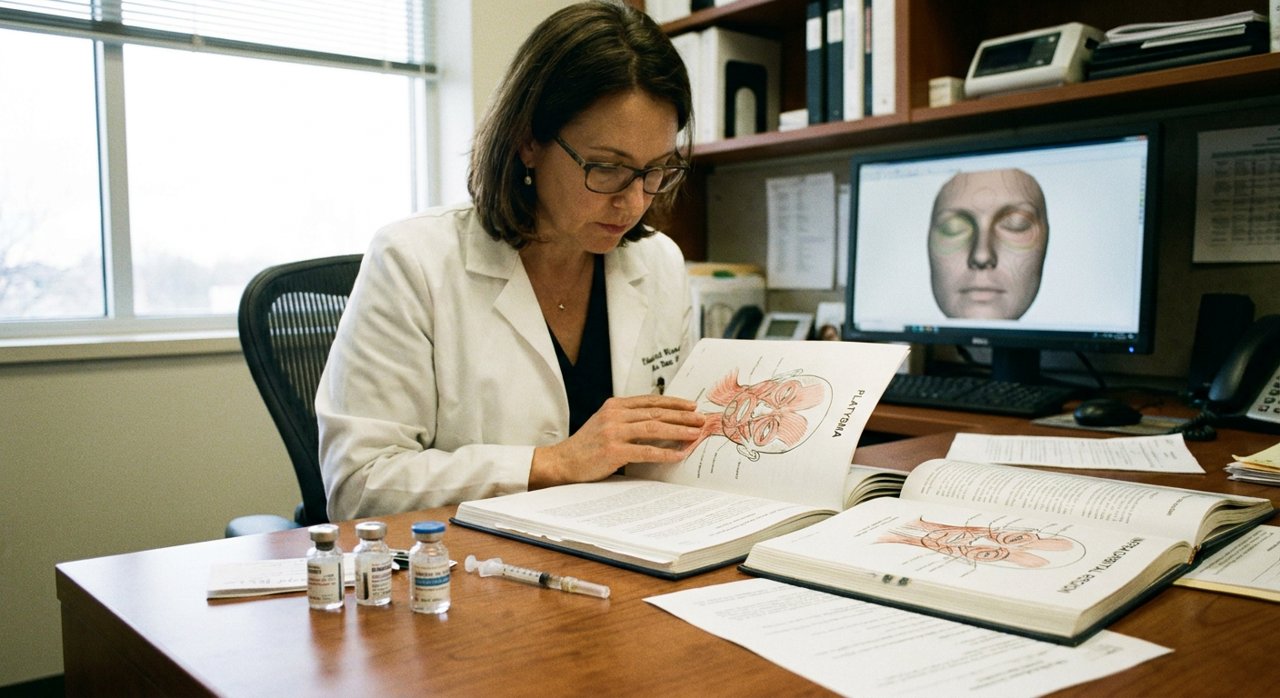
Most of us reach for filler when a patient points at their under-eye hollows. This study asked whether you can lift the lid-cheek complex without putting anything into the tear trough at all.
Published August 26, 2023 in the Journal of Cosmetic Dermatology, it was a prospective interventional study in 35 volunteers (24 women, 11 men, mean age 39.8, mean BMI 25.2). The investigators injected a neuromodulator low, into the supra-mandibular segment of the upper platysma, four points per side at 5 IU each (20 IU per side). Both infraorbital regions were tracked with clinical scales and semi-quantitative 3D imaging at baseline, 15 days, and 30 days.
Two separate effects showed up, and the difference is the whole point. The 3D scans found a small volume gain of 0.13 cc at 15 days (p=0.001) that had essentially disappeared by day 30 (0.02 cc, p=0.452). The lift held up longer: skin moved upward 0.54 mm at 15 days and was still displaced 0.31 mm at day 30 (both p<0.001). Tear trough, palpebromalar groove, and lid-cheek junction severity all improved versus baseline (all p<0.001). The mechanism is biomechanical, not volumizing. Relaxing the upper platysma releases its downward pull on the midface, letting the infraorbital region settle upward.
The practical read: for mild hollowing in a filler-shy patient or a poor tear-trough candidate, a low-dose platysmal placement can give a real but modest lift. Counsel that it is sub-millimeter, peaks near two weeks, and complements filler in deeper hollows rather than replacing it.
Source: Journal of Cosmetic Dermatology (Vol 22, Issue 11). https://pubmed.ncbi.nlm.nih.gov/37632259/